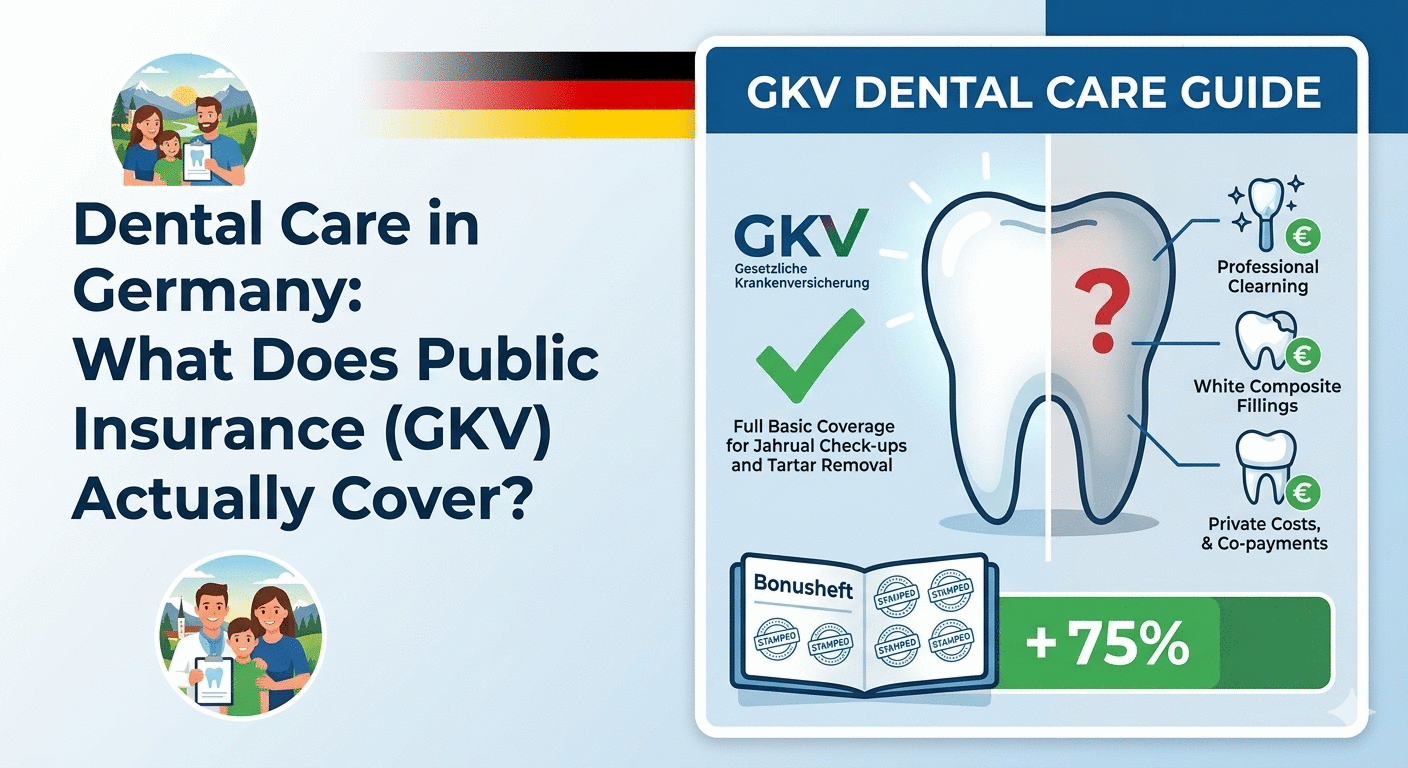
Navigating the German healthcare system is full of surprises, and dental care is often the biggest one. Many expats arrive in Germany assuming that their Statutory Health Insurance (GKV) covers everything. However, when it comes to the dentist, the rules change.
If you want to avoid "sticker shock" after your first check-up, here is exactly what the public system pays for—and what comes out of your pocket.
The Basics: What is 100% Covered?
For standard treatments, your GKV (like TK, AOK, or Barmer) provides a solid safety net. As long as the treatment is considered "necessary and economical," the insurance covers:
- Annual Check-ups: One or two routine examinations per year to monitor your dental health.
- Tartar Removal (Zahnsteinentfernung): Usually covered once a calendar year.
- Simple Fillings: Basic amalgam (silver) fillings for back teeth or composite (white) fillings for front teeth are fully covered.
- Emergencies: If you have acute pain or an infection, the emergency treatment is covered.
The "Surprise" Costs: Where You Have to Pay
The system follows the principle of providing basic care. If you want something more modern or aesthetic, you will likely receive a "private" bill for the difference:
- Professional Tooth Cleaning (PZR): Most public insurers do not cover the full cost (approx. 100€ – 150€). Some may offer a small subsidy (e.g., 40€ per year), but you usually pay upfront.
- High-End Fillings: If you want white composite fillings on your back teeth instead of silver amalgam, you must pay the price difference (the "Mehrkosten").
- Root Canals & Crowns: The GKV only covers a percentage of the "standard" solution. If a tooth is hard to save, they might only pay for an extraction, leaving the expensive root canal costs to you.
The Secret to Saving Money: The Bonusheft
This is the most important document for your wallet. The Bonusheft (Bonus Booklet) tracks your annual visits.
- 5 Years of entries: If you prove you've had a check-up every year for 5 years, the GKV increases its contribution to your dental crowns or bridges by 60%.
- 10 Years of entries: The subsidy increases to 75%.
Pro Tip: If you forget even one year, the clock resets to zero! Always make sure the dentist stamps your book.
Should You Get Supplemental Dental Insurance?
Because major dental work (like implants) can cost thousands of euros, many expats choose a Zahnzusatzversicherung (Supplemental Dental Insurance).
This private top-up can cover 100% of professional cleanings and expensive implants for a small monthly fee (usually 15€ – 30€).
Summary for Expats:
- Public (GKV) is great for prevention and emergencies.
- Bonusheft is mandatory for long-term savings.
- Extra Insurance is highly recommended if you value aesthetics or have a history of dental issues.