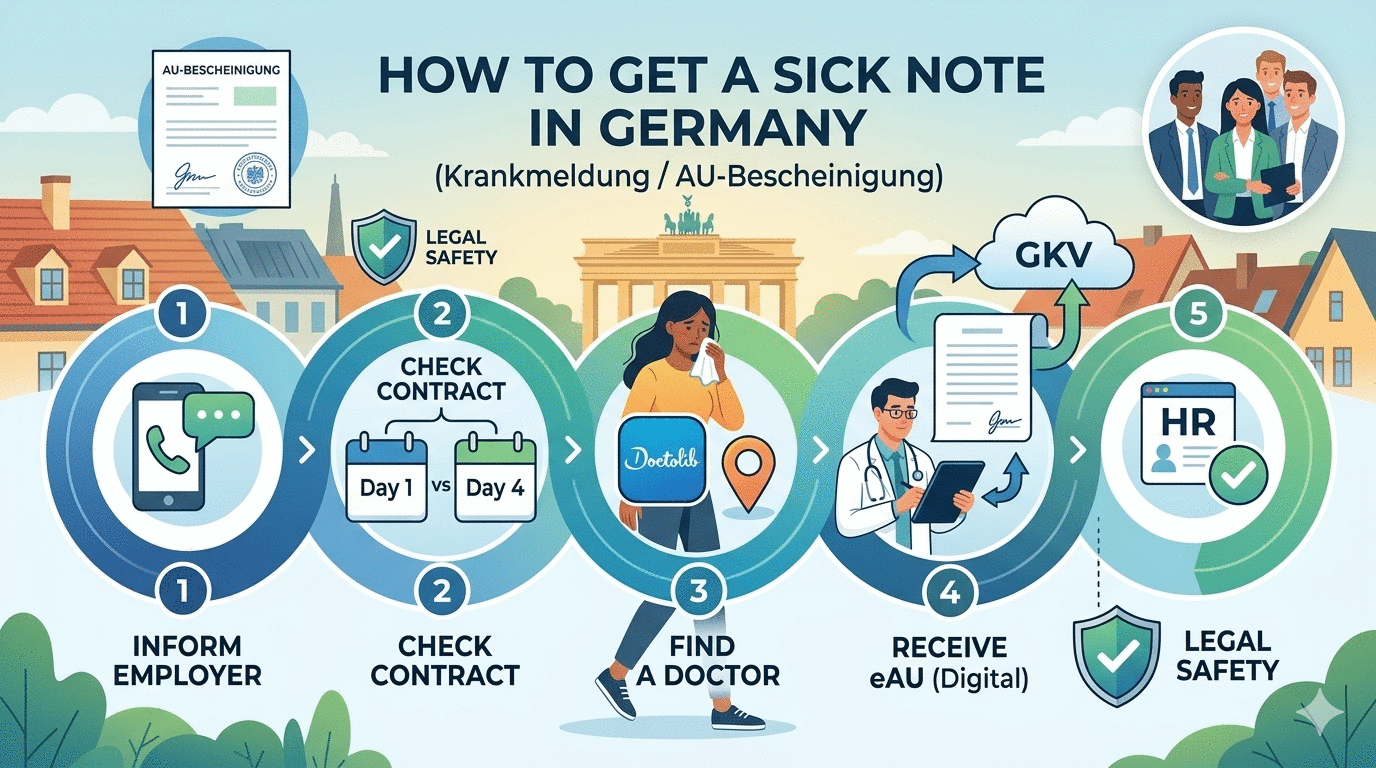
Getting sick in a foreign country is stressful, and navigating the German bureaucracy while feverish is a daunting task. In Germany, "calling in sick" is a formal process that requires precise steps to protect your job and ensure you continue to receive your salary.
Whether you have a simple flu or a more serious condition, here is the definitive, expat-focused guide on how to get your official Krankmeldung—officially called an AU-Bescheinigung (Arbeitsunfähigkeitsbescheinigung)—step by step.
Step 1: Inform Your Employer Immediately
Do not wait until you have a doctor's note. The moment you realize you are too sick to work, you must notify your employer.
- When: By your normal start time on the first day of illness, at the latest.
- How: Check your employment contract. Some companies require a phone call, but an email or Slack message is often sufficient. The key is immediacy.
- What to say: You don't need to disclose your medical condition. Just state that you are sick and unable to work, and give an estimated duration if possible.
Step 2: Know the "3-Day Rule" (and your Contract)
This is where most expats get confused.
- The Standard Rule: Under German law, you must present a doctor's note to your employer if you are sick for more than three consecutive calendar days (this includes weekends). You must submit it on the fourth day.
- The Critical Check: Read your employment contract! Your employer has the right to demand a doctor's note from the very first day of illness. Many companies, especially startups, require this. Failing to provide one is a breach of contract.
Step 3: Find a Doctor (Hausarzt / GP)
If you don't have a Hausarzt (General Practitioner) yet, finding one while sick is tough.
- How: Use an app like Doctolib to find an English-speaking GP and book an appointment online. This is often the fastest route.
- The alternative: You can also call local practices (Praxis). Look for those that offer an open "Sprechstunde" (walk-in hours), but be prepared to wait.
- What to bring: Your health insurance card (GKV or PKV) and your passport.
Step 4: The Consultation and the "eAU"
At the doctor's office, explain your symptoms. If they deem you unable to work, they will issue your AU-Bescheinigung.
- Digital Revolution (eAU): Since 2023, the process is mostly digital for those with Statutory (Public) Health Insurance. The doctor automatically sends the sick note (called eAU) directly to your insurance provider (e.g., TK, AOK).
- What you must do: Your employer does not get the note automatically. You must inform your HR department that the eAU is available, and they will request it from your insurer.
Step 5: After your Recovery – Filing the AU
Even with the digital system, you still have responsibilities:
- Keep Your Copy: The doctor will still give you a printed copy (or a PDF) for your own records. Always keep this safely.
- Submit Your AU (If Private): If you have Private Health Insurance (PKV), the digital eAU system does not apply. You must receive the physical, stamped note from the doctor and mail (or scan and upload) it to your insurer yourself.
Summary and Key Vocabulary for Expats
Navigating the sick leave process is vital for your legal safety in Germany. Remember these three pillars:
- Immediate Notification: Inform your boss first.
- Know your Contract: Is the AU required from Day 1 or Day 4?
- The Digital System (eAU): For GKV users, the note goes to the insurer, but you must still tell HR to retrieve it.